
Why Real-Time Dashboards Are Replacing Traditional Reporting in Modern Marketing
How live campaign visibility is changing what it means to run a successful brand activation
Introduction: From Reporting After to Managing in the Moment
Picture this: your brand has just wrapped a three week, multi city activation. Hundreds of field agents. Dozens of retail touchpoints. A significant media budget. Now imagine discovering, after the campaign has already ended, that a key market was missed entirely, placements were wrong across multiple locations, and you have no reliable way to tell which sites actually performed.
This is not a hypothetical. For a long time, it was simply how marketing operated. And while the tools have evolved, many teams are still running modern campaigns on outdated reporting systems and paying the price for it.
The shift from retrospective reporting to live campaign intelligence is one of the most significant operational changes in the marketing industry today. To understand why it matters, it helps to first understand what traditional reporting actually is and where it falls short.
Traditional Reporting: A System Built for a Slower World
Traditional campaign reporting refers to the process of collecting, compiling, and reviewing campaign data after activities have taken place. Field agents submit status updates, photos, and completion logs often manually which are then aggregated into spreadsheets or slide decks and delivered to stakeholders on a weekly or end of campaign basis.
On the surface, this approach seems functional. Data is being collected. Reports are being shared. Decisions are being made. But the key word in all of that is after. Traditional reporting is, by design, a backward looking system. It tells you what happened not what is happening. And in the context of time sensitive, multi-location campaigns, that distinction is everything.
The Cracks in the Foundation: Where Traditional Reporting Breaks Down
Traditional reporting works well enough when campaigns are small, slow moving, and easy to monitor. But in modern marketing where activations span cities, involve dozens of field agents, and run on tight timelines its limitations become significant.
Delayed visibility is the most obvious problem. When data arrives days or weeks after execution, any issues that occurred during the campaign are already locked in. There is no opportunity to course correct, reallocate resources, or address underperformance. By the time anyone sees the report, the moment has passed.
Verification gaps are equally damaging. Without live tracking, brands have no reliable way to confirm whether activities actually happened at the right location, at the right time, and to the right standard. Photos can be mislabeled. Reports can be assembled from memory. A 2022 study by Nielsen found that field execution errors affect roughly 25% of retail marketing campaigns, and many go undetected until post-campaign audits. By then, corrective action is impossible.
Manual data collection introduces additional failure points. The more people involved in compiling a report, the more room there is for human error and the longer it takes. For large campaigns, this process can consume significant time and resource that would be better spent on actual campaign management.
Accountability gaps are a downstream consequence of all the above. When execution is unverifiable and reporting is delayed, it becomes very difficult to hold teams, agencies, or field partners accountable for performance outcomes. Conversations shift from clear diagnosis to debate and that rarely leads to improvement.
From Blind Spots to Full Visibility: What Real Time Dashboards Actually Do
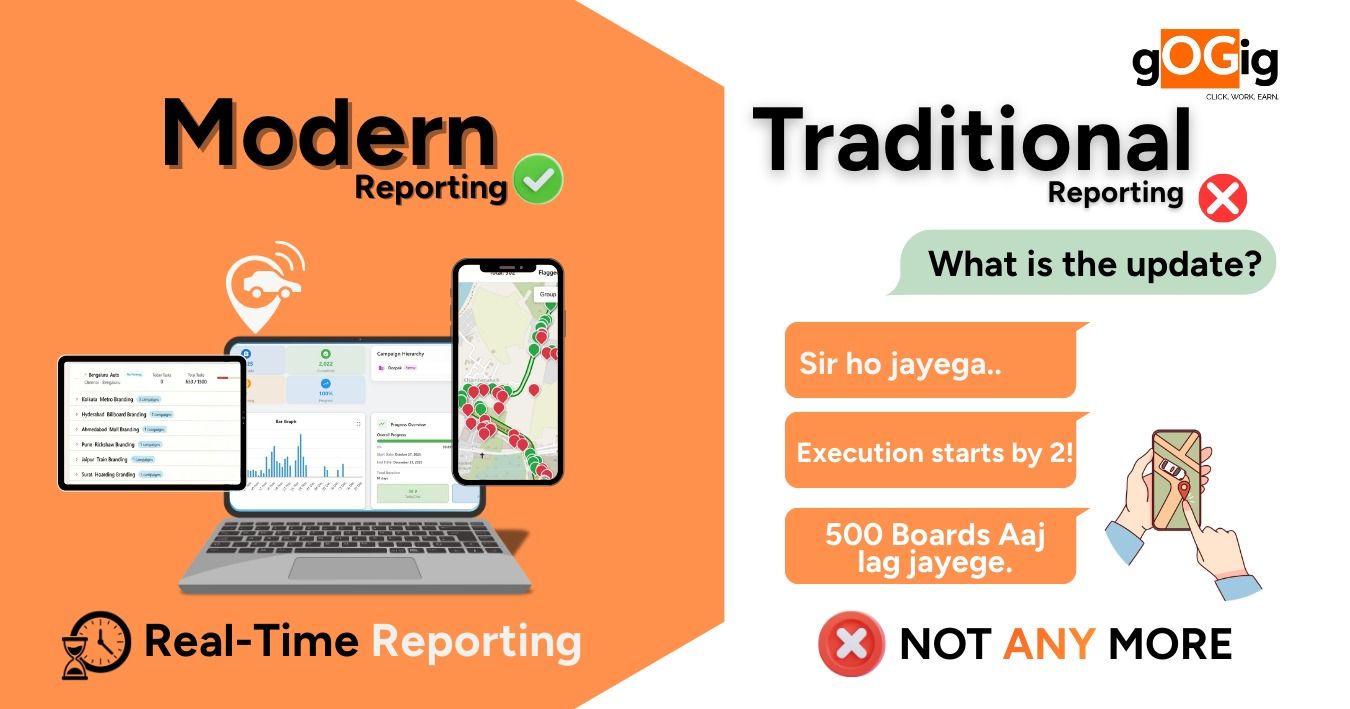
A real time campaign dashboard is a centralized platform that aggregates field activity geo tagged photos, execution logs, agent check ins, delivery confirmations and surfaces it live to marketing and operations teams. Rather than waiting for a weekly or end of campaign summary, managers can see the current state of their campaign at any given moment.
The shift this creates is not just technical. It is organizational. Instead of managing a campaign by reviewing what happened, teams manage it by responding to what is happening. That changes the fundamental role of a campaign manager from historian to operator.
At a functional level, real time dashboards typically offer live execution tracking across multiple locations and agents, geo-tagged and time stamped proof of activity for instant verification, automated alerts when activities fall behind schedule or fail compliance checks, consolidated reporting that eliminates manual data aggregation, and cross team visibility that keeps brand, field, and logistics teams aligned throughout the campaign not just at the end of it.
Speed, Accountability, and Control — The Real Time Advantage
The benefits of real time dashboards go well beyond convenience. They translate directly into campaign performance outcomes.
Faster course correction is perhaps the most immediate advantage. When a field team misses a retail placement or a display goes up incorrectly, a real time dashboard surfaces the issue within hours, not weeks. Brands using live tracking platforms have reported reducing average issue resolution time from five to seven days with traditional reporting to under 24 hours. Across a multi week campaign, that kind of responsiveness can mean the difference between a successful activation and a wasted budget.
Stronger accountability and fraud prevention follow naturally from real time verification. Geo-tagged execution proofs tied to specific time windows make it significantly harder to submit false or duplicate reports. In campaigns that rely on third party field agents or contractors, unverifiable reporting creates an environment where shortcuts go unnoticed. Live verification closes that gap and shifts the trust dynamic between brands, agencies, and field partners from debate to clear, evidence based diagnosis.
Better resource allocation becomes possible when you can see where things are working and where they are not during the campaign, not after. Marketing teams can identify underperforming locations or regions and redirect resources accordingly in real time. This kind of dynamic, responsive allocation is simply not possible with batch-based reporting.
Cleaner, more credible reporting is a secondary benefit that compounds over time. When data is captured automatically and verified in the moment, end of campaign reports become more reliable and more useful as benchmarks for future planning. You are not guessing at what happened. You know.
A Better System Wins - Here's Why the Industry Is Moving On To Real-Time Dashboards
The adoption of real-time dashboards is not just a trend it reflects a fundamental mismatch between how modern campaigns operate and what traditional reporting was designed to handle.
Consumer attention is fragmented. Campaign windows are shrinking. Activations now span more locations, more channels, and more partners than ever before. In that environment, a reporting system that delivers insights days after the fact is not just inconvenient it is structurally inadequate for the job.
Real time dashboards address the core failure modes of traditional reporting directly. They move visibility from retrospective to live. They replace unverifiable manual data collection with automated, geo tagged proof. They shift accountability from ambiguous to clear. And they give marketing teams the one thing that traditional reporting cannot offer: the ability to act on information while it still matters.
Platforms like gOGig are built specifically for this kind of field marketing visibility. By capturing verified execution data at the moment of activity and surfacing it on a live dashboard, they give brands a real time record of what is happening across their entire activation without relying on manual reporting or end of campaign summaries. For teams running large, distributed campaigns, that kind of infrastructure is not a luxury. It is what makes meaningful accountability possible.
The broader shift is already well underway. As more brands experience firsthand the operational and performance advantages of live campaign intelligence, the bar for what counts as adequate visibility is rising. Teams that continue to rely on traditional reporting are not just working with less information they are working with the wrong kind of information for the campaigns they are trying to run.
Conclusion: Stop Reviewing. Start Responding.
Traditional campaign reporting was not built for the pace or complexity of modern marketing. It produces insights too late to act on, makes verification unreliable, and leaves campaign managers making consequential decisions on incomplete information.
Real time dashboards solve each of these problems not by adding more data, but by making the right data available at the right time. For brands running multi location activations, field based campaigns, or any program that depends on distributed execution, the move to live campaign intelligence is less a strategic upgrade and more a basic operational requirement.
The tools are available. The case is clear. And the cost of waiting is a campaign that could have been fixed but wasn't.